Friday, August 12, 2011

The Coal Hard Truth Forum


Answers about the proposed coal terminal at Cherry Point

7 - 9 p.m., August 16
Birch Bay Bible Community Church
7039 Jackson Road, Birch Bay

There are a lot of questions about the controversial proposal to build North America's largest coal terminal next to the Cherry Point Aquatic Reserve. Come to the Coal Hard Truth forum to get answers about the project proposal, its potential impacts on hum and ecological health, and how coal consumption impacts us all.

Learn more about: The terminal proposal itself -- Coal dust from the terminal -- Health impacts from 18 more trains a day -- Where we are in the regulatory process -- Regional and international perspectives -- What you can do

Sponsors: Sierra Club, RE Sources, and Climate Solutions

rah


Wednesday, August 10, 2011

About Community Councils

At the recent Birch Bay forum for County Executive candidates, David Stalheim suggested that, if incorporation is not feasible now, we might consider a community council such as some operated in Chelan County.

I've taken a quick look at two councils in unincorporated Washington communities – Manson with about 3,500 people near Chelan, and Peshastin, much smaller, near Leavenworth. Both councils, I was told, grew out of the groups that had created their UGAs.

At www.peshastin.org you will find the by-laws of their council, which has seven members who serve three-year terms. They “have no legal authority to impose binding conditions, contracts or requirements...but may issue advisory opinions.” Members serve without compensation; the council has no borrowing authority, but may solicit donations and distribute funds.

As illustrated, the Peshastin Community Council (blue line) covers a larger geographic area than the UGA (salmon line with purple fill). The larger salmon/purple area to the upper left is Leavenworth.

LilithYanagumachi, a long-range planner, of the Chelan County Department of Community Development, said that the councils are helpful in establishing zoning criteria and in representing their communities to the County Commissioners. But she added that individuals coming before the commissioners can have as much stature as the councils.

Members of the council, whose terms are rotated, are elected at annual meetings. Cathy Springer, vice chair of the Peshastin council, explained that candidates – she called them “volunteers” – complete an application form that includes the signatures of 10 people who endorse the candidacy. At the meeting, the forms are on display and voters put names they are voting for in a box. Ms. Springer added that at the last meeting, when she was re-elected, there was only one candidate each for the two vacant positions.

Interest in the council heats up, she said, “When crap hits the fan.”

On the last Saturday in July, Friends of the Peshastin Library held an ice cream social that brought the community together and raised funds for the public library.

ak

Wednesday, August 3, 2011

Four Strong Contenders for County Executive

The take-home from last Thursday evening's forum is that we are fortunate to have four strong candidates for County Executive. With mail-in ballots now out, the “non-partisan” primary election goes on until August 16. The two leaders from that vote will contend for the general election in November.

Tom Anderson told us he is the engineer administrator with problem solving skills. After a somewhat rocky opening statement that he read, Anderson demonstrated that he is a skilled communicator. His spontaneous answers to questions were miniature essays of clarity.

Doug Erickson is the seasoned politician, born with charisma, who has served in the state legislature for the 13 years since he was age 28. One of the state's strongest proponents for free enterprise, he said he believes businesses create jobs. If Erickson becomes County Executive, he could make Whatcom County into a little Texas – there are parallels in refining and farming. You can imagine how he might become a candidate for governor.

A robust Jack Louws comes on as experienced in both government, as an two-term mayor of Lynden, and business man, who headed a successful truss manufacturing company inherited from his father and now passed on to his son. Living in Birch Bay, he demonstrated an interest in the community and ventured the advice that incorporation would require urban streets that are more expensive than rural roads.

David Stalheim, ousted as the county's planning director and the progressives favorite was a pleasingly smart and witty debater. In contrast to Erickson, he said government can provide the framework for businesses to create jobs. His most telling point was that the county is sitting on an economic development fund of over $10 million from which only $1.5 million has been spent to improve the civic center. He suggested that some of that money could be invested in Birch Bay's berm project. Stalheim could win if Bellingham liberals rally to get out their vote in opposition to the Tea Party followers who dispute the state's growth-management act. Asked for advice for Birch Bay on incorporation, Stalheim said that first the county executive should sit down with community leaders to review the feasibility study that has been largely ignored. An alternative, he suggested, could be a “community council” similar to that operating in Manson, a resort community on Lake Chelan

This debate, hosted by Kathy Berg, of the Birch Bay Steering Committee, and moderated by John Gargett, President of the Birch Bay Camber of Commerce, spoke well for the potential of the community.

~~

About the coal trains, the consensus in this discussion was largely that, if environmental controls are established and enforced, the bulk coal dock at Cherry Point could be approved.

A detailed discussion of this issue can be found at www.getwhatcomplanning.blogspot.com, operated by Jean Melious and David Stalheim

ak

[Comments gratefully encouraged.]

Saturday, July 23, 2011

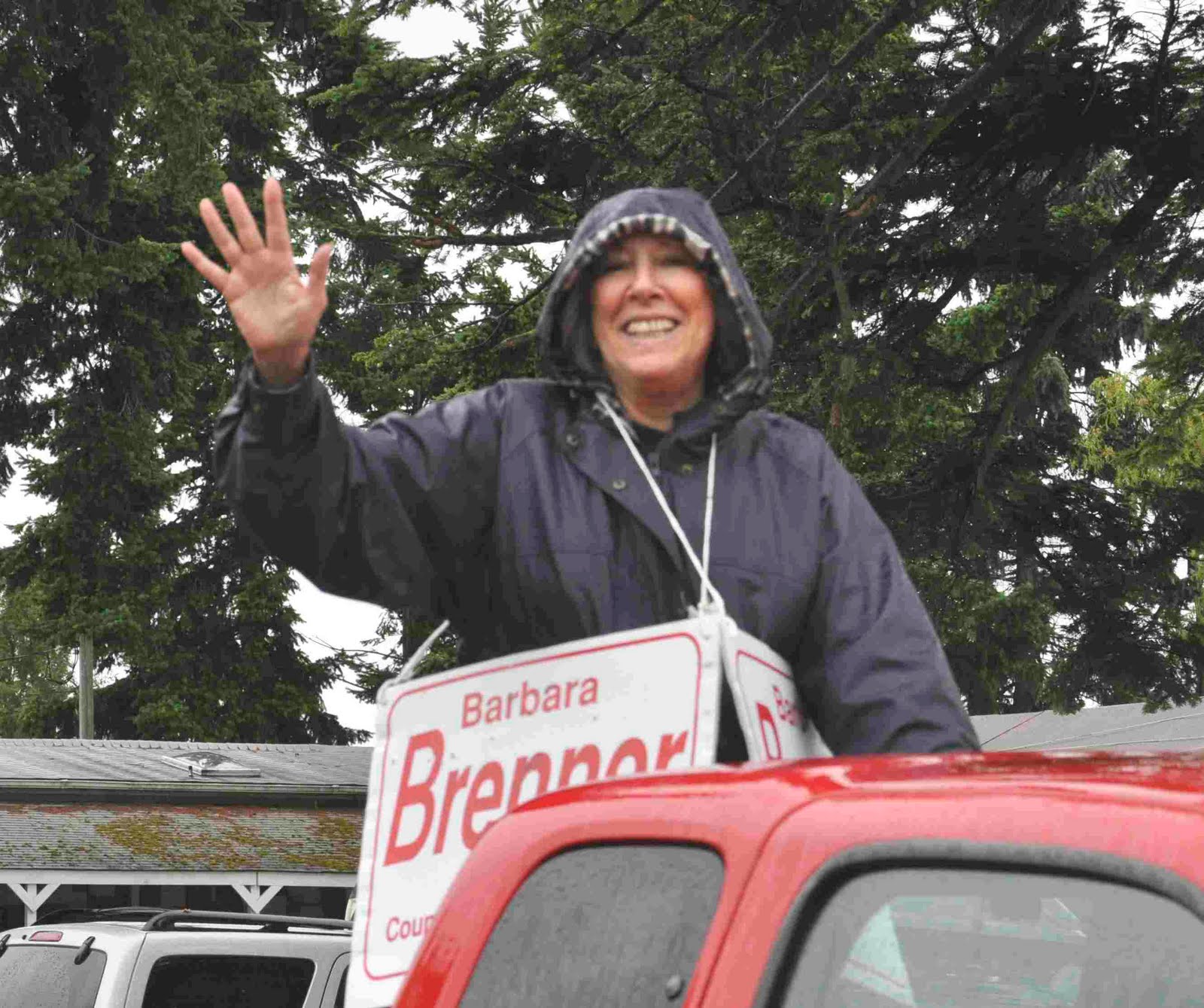
The first parade participant we saw out our window on Saturday, July 16, 2011, was the indefatigable County Council member, Barbara Brenner, in rain garb, standing in the bed of a red pickup truck. When last seen Brenner, currently the longest serving Council member, was still standing on the truck.

Flush from a positive article that week in the Cascadia Weekly, Tom Anderson, described by editor Tim Johnson as an “underdog in the race for County Executive”, wearing just a suit despite the drizzle, walked the whole parade route speaking enthusiastically to bystanders. (Unfortunately, many were not Whatcom voters.)

But the most exhuberant campaigner was Ruby May, who darted from one side of the parade to the other putting Anderson cards, fortunately encased in plastic, in the hands of smiling participants regardless of residence. Little Miss May was celebrated in Whatcom politics in 2009 when she appeared tearfully before a closed library in an ad that was credited with winning that levy.

Ruby is the daughter of Richard May, who managed that campaign. The previous year he was an organizer for Barack Obama in several states. Richard, who was also passing out Anderson cards, said he is working for him and other Democrat candidates in Whatcom.

Found standing quietly among the onlookers before Sunday's Ducky Derby, was Bellingham's mayor, Dan Pike. Congratulated for his stand against the coal trains and the proposed pier at Cherry Point for shipping coal to China, he said he is pleased that the mayors of Seattle, Tacoma and other cities have joined the fray. And he is particularly pleased that the Washington Department of Ecology has also joined. “That means,” he said, “Whatcom County will not foot the legal bills.”

ak

Monday, July 11, 2011

Learning About Community Gardens

For six months we planned a trip to Boston for a commencement ceremony of Ruth's granddaughter who finished at Emerson College in December; they have only one ceremony in May. Originally, the plan was to drive the whole way there and back, and we spent hours plotting distances between what we thought would be interesting points along Highway 2 – there weren't very many.

However, after filling our gas tank one day for almost $50, we concluded in unison: “Let's fly.” We boiled our “interesting places” down to two: Cape Cod, which we had both visited years ago, and the Berkshires that neither of us had explored before.

On the Cape we had a timeshare with room enough for Ruth's son and his family, four people including the graduate. This was at Falmouth, a very nice town at the inner Cape. But the weather was disappointingly like Birch Bay: rain most days.

On a walk in Falmouth one morning we explored a neat housing development – houses are spiffy on the Cape – that led to a community garden, which supplies a food bank. Spaces with water and tools are free with the understanding that participants will donate half of what they grow to the food bank, as explained by this local. He said most of the growers work hard. Generally, the beds looked impressive. Only one plot looked abandoned, and our friend said the other gardeners would be patient until taking action to expel that individual to make room for someone on the waiting list.

For several years we have talked about developing a community garden on the small lot where we've been “Farmers Growing Trees for Salmon.” This Fall the trees will be gone and the program closed.

Last year we built and planted a sample raised bed. When we returned from our trip we found our lettuce was growing well. But the cost of the raised bed makes that approach impractical. In the Spring we will offer ground spaces for planting.

For the Berkshires we scheduled a visit to the Nutrition Center in Great Barrington that is operated by Peter Stanton, nationally known for helping children prevent obesity. His message is, “Eat more vegetables.” He finds that when kids learn to cook vegetables they will want to eat more. In his kitchen the appliances and table are at kid height.

Naturally, he has a community garden on his property and the weekly farmers market is held on adjacent property that belongs to the hospital that is nearby. While clients of the Nutrition Center are all ages and incomes – half of the Center's revenue is from physician referrals paid by insurance – he wants to garden to have low-income growers who are charged $30 per year. “When people pay, they care,” Peter explains.